By Shubhneet Goel, Co-Founder and Director of Technology at InboxAlly. InboxAlly were finalists in the ‘Most Innovative SaaS Solution’ and ‘Best SaaS Solution for Sales / Marketing / CRM’ awards at the 2026 SaaS Awards.
Cloud businesses closely monitor application uptime, API performance, databases, payment systems, and identity platforms. Once those systems send an email, however, that scrutiny often ends. The message is marked as sent, and everyone assumes it arrived.
That assumption is risky. Email supports critical processes, from password resets and security alerts to invoices, onboarding, service updates, and customer support. In many cases, it is the step that allows the workflow to continue.
A successful send only confirms that the platform accepted the request. It does not confirm that the message reached the inbox. The receiving provider may delay, block, or filter it into spam while the original system still appears to have worked.
Cloud adoption has also added complexity. Messages may now come from CRMs, billing platforms, identity services, support tools, and product workflows across multiple vendors and sending environments. Each platform introduces another domain, integration, authentication record, or source of sending activity to manage.
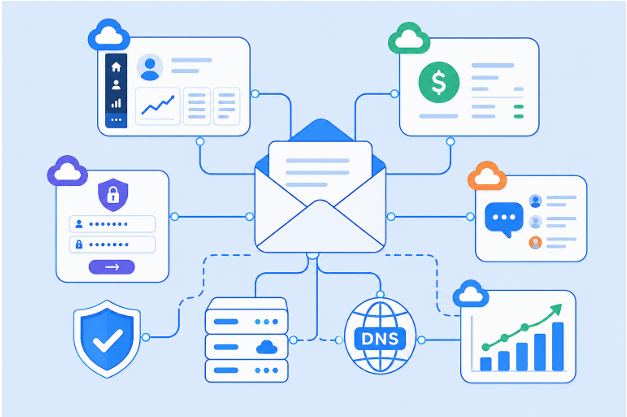
The gap between sending and reaching the inbox
Email passes through several systems before it reaches the recipient. A cloud application generates the message, an email service provider processes it, and the receiving mail server evaluates it. The mailbox provider then decides whether to accept, reject, delay, or filter the message.
A successful response from an email API or SMTP service confirms only that the sending platform accepted the request. Server acceptance means the receiving system agreed to take the message. Neither result guarantees inbox placement or recipient visibility.
An accepted email may still land in spam, reach a low-priority folder, or arrive too late to be useful. A password reset that appears after the user gives up has failed its purpose, even if the platform reports a successful send.
Conventional reporting can therefore create false confidence. The workflow is complete only when the recipient can access the message and take the intended action.
Every email relies on an infrastructure chain
Inbox placement depends on more than the application generating the message. It is also shaped by the email service provider, the sending domain or subdomain, IP infrastructure, DNS records, authentication, routing, and sender history.
SPF helps receiving systems check whether a message was sent from a server authorized for the domain, while DKIM helps verify that the domain owner sent it. DMARC checks whether SPF or DKIM authentication aligns with the domain shown in the From header and tells receiving servers how to handle messages that fail those checks. Mailbox providers then apply their own filtering systems, using signals such as complaints, engagement, and previous sending behavior.
Email, therefore, operates much like a distributed cloud service. Its performance depends on several connected components, some controlled by the sender and others managed by external platforms. A weakness in one layer can affect the outcome of the entire delivery chain, even when the rest of the system appears to be working.
One of the most important choices within that chain is whether the organization sends through shared IP infrastructure or uses a dedicated IP.
Shared and dedicated IPs require different operating models
A shared IP pool allows multiple organizations to send through the same infrastructure. The provider usually manages the pool and much of the reputation monitoring. This can suit lower or inconsistent sending volumes, but the reputation of the pool may also be influenced by other senders using it.
A dedicated IP gives one organization greater control over its sending reputation, but it also requires more active management. The sender must maintain sufficient volume, send consistently, monitor performance, and build reputation over time. A poorly managed dedicated IP can create more risk than a well-run shared environment.
The right choice depends on message volume, business criticality, risk tolerance, internal expertise, monitoring capacity, and how heavily the organization relies on email. As with other cloud infrastructure decisions, greater isolation only adds value when the organization has the resources to manage it properly.
ESP architecture determines how well risk can be contained
Choosing an email service provider is more than a procurement or integration decision. The provider’s architecture affects how messages are sent, monitored, and separated across the business.
Key considerations include how shared IP pools are managed, whether dedicated infrastructure is available, and whether transactional and promotional traffic can be kept apart. Authentication support, throttling, bounce and complaint handling, reputation visibility, migration support, and access to delivery data also affect how much control an organization has.
Treating all email as one stream can create unnecessary exposure. A surge in promotional volume, for example, may affect transactional messages when both rely on the same domain, subdomain, or sending infrastructure. This makes it harder to isolate problems and protect messages such as password resets, account alerts, and billing notices.
ESP architecture therefore plays a direct role in risk management. The simplest or lowest-cost platform may not be the lowest-risk choice once email supports critical workflows.

Young happy professional business woman worker employee sitting at desk working on laptop in corporate office. Smiling female student using computer technology learning online, doing web research.
DNS authentication supports reliability and security
Email authentication connects deliverability, security, and domain management. SPF identifies which servers are authorized to send for a domain. DKIM adds a cryptographic signature that supports message integrity, while DMARC tells receiving systems how to handle authentication failures and provides reporting on them.
The operational importance of these controls is reflected in current provider requirements. Google requires senders delivering more than 5,000 messages per day to personal Gmail accounts to implement SPF, DKIM, and DMARC, maintain valid forward and reverse DNS records, and use TLS.
These controls help mailbox providers assess whether a message is legitimate. They also reduce exposure to spoofing and impersonation and influence delivery decisions. Their effectiveness depends on accurate DNS management. Records can become outdated when organizations change vendors, add new sending platforms, restructure domains, or migrate systems. A malformed or incomplete record is therefore a cloud configuration and identity-management weakness, not simply a campaign error.
Responsibility is often split across teams. Marketing owns the campaign, IT controls DNS, security protects the domain, and external platforms handle the send. Without coordination, critical changes can be missed.
Sender reputation is built over time
Sender reputation reflects the trust an organization has earned through its sending history. Mailbox providers may assess complaint rates, bounces, sending consistency, volume changes, authentication, engagement, list quality, and domain or IP history when deciding how future messages should be handled. [7]
There is no single universal score. Gmail, Microsoft, Yahoo, and other providers use their own signals and systems, so performance can vary between inbox providers.
Changing ESPs does not necessarily solve the problem. A migration may replace part of the infrastructure, but it does not remove the reputation attached to the sending domain or correct the behaviours that damaged it.
Once weakened, sender reputation can affect an organization’s ability to reach customers, employees, and partners across both promotional and operational email. Its value becomes clearer when performance is measured over time.
In an InboxAlly case study, direct-to-consumer ecommerce company Seido Knives saw its sender score rise from approximately 45 to 75 over eight months. During the same period, its Google Postmaster domain reputation moved from Low to High, while spam-folder placement fell from more than 20% to under 2%.
The length of that recovery is significant. It shows why sender reputation should be managed as a long-term operational asset rather than treated as a campaign metric that only receives attention after performance declines.
Email needs observability, not just campaign reporting
Campaign metrics such as opens, clicks, conversions, revenue, and unsubscribes remain useful, but they cannot explain every delivery problem.
Operational monitoring should also track authentication failures, bounces, complaint rates, domain and IP reputation, provider-specific changes, blocklisting, delays, deferrals, and inbox placement. It should show what changes after a DNS update, platform migration, or adjustment to sending architecture.
Marketing metrics often reveal the symptom after the underlying issue has already developed. A drop in conversions may appear to be a content problem when the real cause is worsening inbox placement.
Cloud teams would not assess an API using only downstream business outcomes. They would monitor errors, latency, dependencies, capacity, and failures. Email requires similar operational visibility.
The ownership gap often creates the greatest risk
The right owner for deliverability is not always the team that sends the email. It should depend on the process the message supports.
A promotional campaign, password reset, invoice reminder, and security alert carry different levels of risk. Each should therefore have an identified service owner, clear performance expectations, and an escalation path when delivery deteriorates.
This requires organizations to map email dependencies across their cloud environment. Teams should know which platforms send each message type, which domains and IPs they use, who controls the relevant DNS records, and what happens if the communication fails.
That approach shifts deliverability from a general shared responsibility to a defined part of service management. Marketing may still oversee promotional performance, while product, finance, security, or customer operations own the reliability of messages tied to their workflows.
Critical transactional email may also require separate infrastructure, monitoring, and controls from promotional traffic. The goal is not to assign every message to one central team, but to ensure that no important communication exists without a clear operational owner.

When email fails, the business process fails with it
Poor deliverability can interrupt the process an email was meant to complete. A password-reset message that lands in spam can leave a customer locked out. A delayed security alert, missed invoice, unseen onboarding message, or late authentication code can create operational and commercial consequences.
The system may still record the message as sent even though the customer experience has already failed.
These failures can increase support demand, delay revenue, frustrate users, and weaken trust in the service. From the customer’s perspective, an email deliverability failure may be indistinguishable from a product failure. They do not see the infrastructure behind the message.
They only see that the expected action did not happen.
What treating email as infrastructure actually means
Treating email as infrastructure means evaluating it according to the workflows it supports, the consequences of failure, and the level of control the organization needs.
That may involve separating critical transactional traffic from promotional sending, treating authentication as core configuration, monitoring performance across mailbox providers, and protecting sender reputation over time. It also means assigning clear ownership and including email in change-management and incident-response processes.
The goal is to give the systems behind important communications the same level of oversight as the applications that generate them.
The key question is no longer whether the platform sent the email. It is whether the communication completed the business process it was designed to support.
Email belongs in the cloud reliability stack
Cloud-native organizations now depend on email across customer experience, identity, security, operations, and revenue. That reliance makes deliverability part of the infrastructure supporting the business, with failures carrying consequences far beyond campaign performance.
The next step is to manage email with the same discipline applied to other critical systems. That means bringing it into conversations about uptime, observability, security, resilience, change management, and operational risk. It also means measuring success by whether important communications reach people in time to support the process they were designed for.
Organizations that continue to treat deliverability as a campaign-level concern may only recognize the underlying infrastructure problem once critical messages begin to fail.

About the Author: Shubhneet Goel

Shubhneet Goel is the Co-Founder and Director of Technology at InboxAlly. With more than a decade of experience in software development, SaaS, cloud technologies, and automation, he has designed and built enterprise-grade systems for startups and established organizations across multiple industries.