By Cheryl Johnson, Chief Product and Technology Officer at Betterworks. Betterworks were finalists in the ‘Best Use of AI in Human Resources (HR)‘ category at The 2024 A.I. Awards.
Artificial Intelligence (AI) is not just another buzzword in today’s workplace; it’s a driving force that promises to transform how businesses operate, particularly in the HR space.
But while AI offers unprecedented opportunities for automation, efficiency, and smarter decision-making, it also stirs up concerns about job displacement, data privacy, and fairness.
For HR leaders, the question isn’t whether to adopt AI—it’s how to harness its potential to improve processes while addressing employees’ legitimate concerns. The stakes are high: today’s HR leaders must champion organizational progress while safeguarding employee well-being.
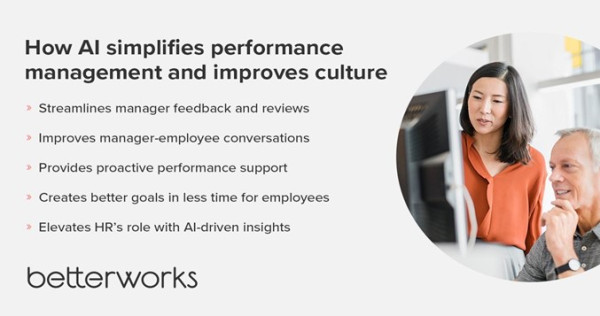
How AI can Simplify Performance Management and Improve Culture
At Betterworks, we understand that performance management has long been a pain point for managers and employees alike. The conventional annual review process is often time-consuming, biased, and backward-looking. In our 2024 State of Performance Enablement report, 44% of employees gave their performance management systems a failing grade. Employees’ responses to performance reviews vary from apathy to angst, and they sometimes leave employees in tears or enraged. Is this any way to encourage the best work from your people?
For companies that are still holding onto the 100-year-old process with clenched fists, there’s a far better option in modern performance management. And now, with the advent of generative AI, performance management is only getting easier and more efficient. AI now has a pivotal role in reshaping performance management by simplifying goal creation, summarizing qualitative and quantitative performance data, enabling comprehensive real-time insights, and simplifying the ability to provide feedback that fosters transparency and growth.
Streamlining Manager Feedback and Reviews
AI tools can simplify performance reviews by collecting, analyzing, and summarizing feedback from multiple sources in real-time. Managers no longer need to spend hours gathering information or manually tracking progress toward goals. With AI, feedback becomes more relevant and actionable, providing employees with timely insights into their performance. These instant, data-driven summaries ensure that feedback is more accurate, objective, and focused on actual performance and contributions. Why do the rote work of consolidating data when AI can handle it far more effectively?

Improving Manager-Employee Conversations
Good questions lead to better conversations. And frequent, honest conversations build the trust and transparency that underpin strong relationships and help supercharge high performance.
AI-driven tools can summarize historical feedback to improve the quality of the conversation prompts and simplify the review process. Knowing what to ask increases a manager’s confidence and gives them more time to focus on strategy and strengthening their team. Employees benefit from receiving clear, targeted coaching. The quality of developmental conversations improves, and a culture of ongoing growth and unbiased evaluation also flourishes. One thing leads to another. Significant personal and organizational advancement become the fruit of these changes—and all in a fraction of the time it has traditionally taken managers.
Providing Proactive Performance Support
Most of us could probably use a personal assistant to keep us on track and remind us of all the activities we must accomplish. AI can serve that role, enhancing performance support by sending timely reminders to managers about check-ins with employees. If a manager hasn’t provided feedback on a particular goal in a while or an employee is struggling to meet milestones, AI can nudge the manager to offer support. These prompts seem small, but they are mighty because they create a culture of regular communication where issues are addressed before they become larger problems, and successes are celebrated as they happen.
In this proactive approach, AI helps managers stay engaged with their teams and ensures that performance discussions happen when they’re most relevant. Employees receive more consistent coaching and recognition, which leads to higher levels of job satisfaction and performance.
Creating Better Goals in Less Time for Employees
One of the most tedious tasks for employees is crafting SMART goals—especially when they don’t have a clear roadmap. However, AI can draw on an employee’s performance data to help them quickly write clear goals with quantifiable metrics that are aligned with their team’s and company’s goals. This removes the guesswork and ensures that employees are working toward meaningful outcomes.
Elevating HR’s Role with AI-driven Insights
By automating administrative tasks, AI allows HR leaders to focus on higher-level strategic initiatives. From recruitment to performance management, AI helps HR shift from a reactive role to one that proactively supports employee engagement and business outcomes. AI-driven insights into the workforce will continue to empower HR leaders to make data-driven decisions. This gives HR teams and leaders more time to focus on transformative work like improving processes and employment experiences—from recruitment through onboarding and performance. In addition, AI will be able to understand the needs of every employee so that HR can create tailored experiences that improve retention and engagement.
Reducing Bias in Performance Reviews and Internal Advancement with AI
The human element in performance reviews has always left room for unconscious bias. Whether it’s gender, race, or simply the proximity of someone’s last achievement, biases can skew the fairness of evaluations. One of the most significant advantages of AI in HR is its potential to reduce bias. In performance management, this translates into fairer and more transparent evaluations and promotions.
Removing Human Bias from Decision-Making
Human nature makes us all prone to subjectivity. It colors what we believe, say, and do. AI, however, can evaluate performance data objectively, focusing on key performance indicators (KPIs) and work outcomes rather than subjective opinions or perceptions. By using AI to aggregate and analyze data on goal completion, project outcomes, and peer feedback, managers can make better-informed decisions that reflect an employee’s actual performance, not assumptions.
AI can also help standardize the review process by suggesting consistent language, removing potentially biased phrasing and offering more objective criteria for evaluation. This means performance reviews and internal advancement decisions are based on consistent and relevant metrics across the organization, helping to eliminate discrepancies and unfair treatment.
This is not to say that AI supersedes human judgment. We have nuanced knowledge and emotion that AI, at least at this point, cannot surpass. It’s similar to comparing a camera lens to a human eye. Unlike the human eye, a camera lens cannot dynamically adjust focus, incorporate information from the surroundings, and process complex visual data in real time.
Building Stronger DEI with Data
When AI is thoughtfully designed and regularly audited to avoid perpetuating existing biases, it can also support diversity, equity, and inclusion (DEI) initiatives. AI tools can help HR identify patterns of bias in historical performance data and enable proactive changes in talent management strategies. For example, AI can highlight the underrepresentation of certain groups in leadership pipelines, prompting targeted development programs to support diverse talent.
Additionally, AI can track patterns in who receives feedback, coaching, or development opportunities, ensuring that these resources are distributed equitably across the organization. By fostering a data-driven approach to talent advancement, AI helps HR leaders build a culture of fairness and inclusiveness, where advancement is based on merit and potential, rather than subjective perceptions and personal networks.

Identify Hidden Skills and promote a Skill-Based Organization with AI
Organizations are shifting toward a skills-based model, where success is measured not just by titles or tenure but by the tangible skills and competencies employees bring to their work. AI has a powerful role to play in this transition by uncovering hidden skills within the workforce and aligning them with business needs.
Uncovering Workforce Skills
Think for a minute about the skills you have that you don’t use in your current role, or that you do use, but which are not necessarily captured in your title. Employees often have skills and competencies that are not immediately apparent from their job descriptions or titles.
AI can analyze large volumes of data from various sources—such as performance reviews, manager-employee conversations, peer feedback, learning and development activities, goals, and internal social networks—to identify these hidden skills. AI can capture and extract those insights and turn them into actionable data for managers and employees. For example, if an employee frequently collaborates across departments or demonstrates project management capabilities outside of their formal role, AI can highlight these as valuable competencies for future roles or projects.
This deeper understanding of the workforce’s skillsets allows HR to better align talent with organizational needs. Employees feel more recognized and valued for their contributions, leading to increased engagement and motivation.
Supporting Skill Development and Career Progression
AI isn’t just for HR admins and top-down planning. It can also support an individual’s career development by helping employees understand how their skills match current and future opportunities within the organization. For instance, AI-powered platforms can recommend tailored learning paths, suggest mentors, or identify internal job opportunities based on an employee’s current skill profile and career goals.
This personalized approach to career development fosters a learning culture, where employees are continuously building their skills and competencies in alignment with business priorities and their future career aspirations. It also supports talent mobility within the organization, helping HR leaders fill skill gaps and build a more agile workforce.
The Future of AI in Work and Performance Management
We’re only scratching the surface of what AI can do in the workplace, and it’s already clear that the potential is massive. AI isn’t just here to automate or make things a little smoother: It will fundamentally change how we manage, develop, and grow our people. As it evolves, AI will reshape performance management and employee development, becoming the engine that drives a more engaged, agile, and high-performing culture.
A Seamless and Integrated Work Experience
As Betterworks’ chief product and technology officer, I am always thinking about how we can leverage technology to make the experience and outcomes of work better—now and in the future. AI applications will be increasingly embedded in the flow of work, providing seamless integration with the tools employees already use daily. This will make performance management more intuitive, with AI continuously gathering data, offering real-time insights, and facilitating ongoing development without disrupting day-to-day tasks.
AI will support employees and managers alike, acting as a “digital coach” that provides personalized recommendations and learning opportunities in real time. For example, if an employee is working on a challenging project, AI might suggest relevant training resources, connect them to a colleague with specific expertise, or offer tips for improving their approach based on past performance data.
AI and the Evolution of the Manager’s Role
As AI takes on more of the administrative and analytical tasks traditionally associated with management, the role of managers will evolve. Managers will shift their focus toward more strategic and human-centered responsibilities—building stronger relationships, mentoring, developing team members, and fostering a positive work culture. AI will cultivate managers’ capabilities, helping them become more effective leaders who can drive both business results and employee growth.

Balancing AI and Human Insight
While AI offers incredible potential, it is not a replacement for human insight. The future of AI in performance management and work will depend on a thoughtful balance between automation and human judgment. AI can provide data, insights, and suggestions, but managers and HR leaders must apply their own expertise and empathy to make the final decisions. In essence, AI’s role is as a co-pilot.
The combination of AI’s analytical capabilities and human empathy and understanding will create a more holistic approach to performance management, where decisions are informed by both data and the human experience. This balance will allow organizations to harness AI’s power responsibly and effectively, driving better business outcomes while maintaining a supportive and inclusive work environment.
Safeguarding Privacy, Ensuring Security
Ensuring privacy and safety when using AI is foundational for building trust and protecting sensitive information. AI systems often handle vast amounts of personal and organizational data, and without strong privacy measures, this data can be vulnerable to misuse or breaches. Ensuring compliance with data protection regulations, such as GDPR, helps protect employees’ rights and confidentiality.
Additionally, AI models must be designed with robust security protocols to prevent unauthorized access, and have equally strict protocols around data retention In some cases, using a private LLM trained to respond in line with core principles and values is necessary to provide trustworthy and accurate outcomes
By prioritizing privacy and security, organizations protect their data, build trust and confidence in AI-driven systems, and ensure they’re safe and effective.
AI as a Catalyst for a Better Workplace
AI’s role in HR is no longer a question of “if” but “how.” It has the power to revolutionize work and performance management for the better, enabling streamlined processes, fairer evaluations, skill-based talent development, and more strategic leadership.
As we embrace AI’s potential, HR leaders and managers have a unique opportunity to redefine work in a way that fosters growth, development, and success for all employees—creating a future where work truly becomes better for everyone involved.

About the Author: Cheryl Johnson